When I have a few agents building a few projects, the problem is not only “did the agent finish?” The harder question is “what is this project becoming?”
A chat log can answer what happened minute by minute. It is much worse at answering what should survive the session. If I have one agent shaping a CLI tool, another turning a product sketch into a web app, and another testing a data model, I do not want to read every transcript just to understand which project has a clear product thesis.
This is where I use Aictx as a local project-state viewer.
Each project gets its own .aictx/ memory. The useful facts stay isolated:
product intent, architecture, known traps, conventions, source records, open
questions, and decisions that should carry into the next session. There is no
shared global memory where one experiment leaks into another.
Then I open the viewer:
aictx view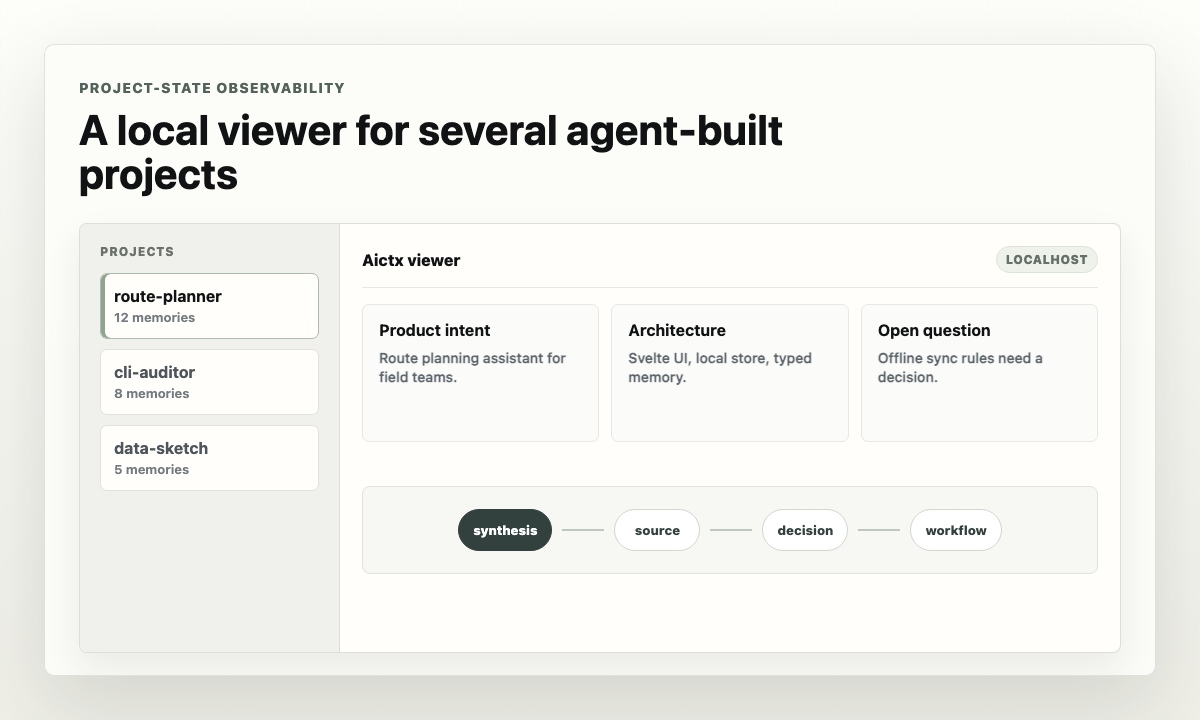
The viewer gives me a dashboard over the local project registry. I can move between projects and inspect what the agents actually made durable: which sources were captured, which decisions were saved, which questions are still open, and which syntheses describe the current product and architecture.
That is the useful layer for me. It is not metrics-and-traces observability. It is project-state observability.
I can see whether a project has a coherent product intent, whether the architecture summary matches the repository, whether the setup workflow is usable, and whether the memory is evidence-backed or just a pile of vague notes.
For concurrent project generation, that distinction matters. A transcript answers “what did the agent say?” Aictx memory answers “what should the next agent or human safely assume about this project?”
The viewer also makes comparison easier. If I have five candidate projects in flight, I can inspect them at the level that matters:
- What is the product intent?
- What stack and tooling did the agent settle on?
- What decisions are source-backed?
- What workflows are ready for another agent to run?
- What open questions would block implementation or review?
That gives me a better control surface. I can decide which project is ready for deeper work, which one needs correction, and which one should be abandoned before more agent time is spent on it.
The important boundary is that Aictx stays local-first. The viewer launches
from my machine, binds to localhost, and reads project memory from the local
registry and each project’s .aictx/ directory. I do not have to send every
generated repository into a hosted dashboard just to see what happened.
For parallel agent work, the loop I want is simple:
aictx setup
aictx load "continue this project"
aictx remember --stdin
aictx view
The agent keeps its working context focused. I inspect the durable state afterward. The next agent starts from what should last, not from whatever happened to be said in the previous chat.